
Fouladou: Making Solidarity the Engine of Shared Prosperity
Beyond infrastructure and economics, the true development of a region is measured by its ability to leave no one behind. In Fouladou, supporting vulnerable populations is organized around a humanistic vision: transforming occasional assistance into a powerful driver of social inclusion.
Identifying to Better Act: Mapping Vulnerability
Supporting effectively first requires understanding. Fouladou, a territory rich in potential but marked by disparities, includes groups needing special attention: female heads of households, isolated elderly people, children in precarious situations, and people living with disabilities.
Action focuses on creating community protection networks, making it possible to identify real needs in order to provide surgical and dignified responses.
Direct Support: Food Security and Housing Access
The first step of support is stabilizing basic living conditions.
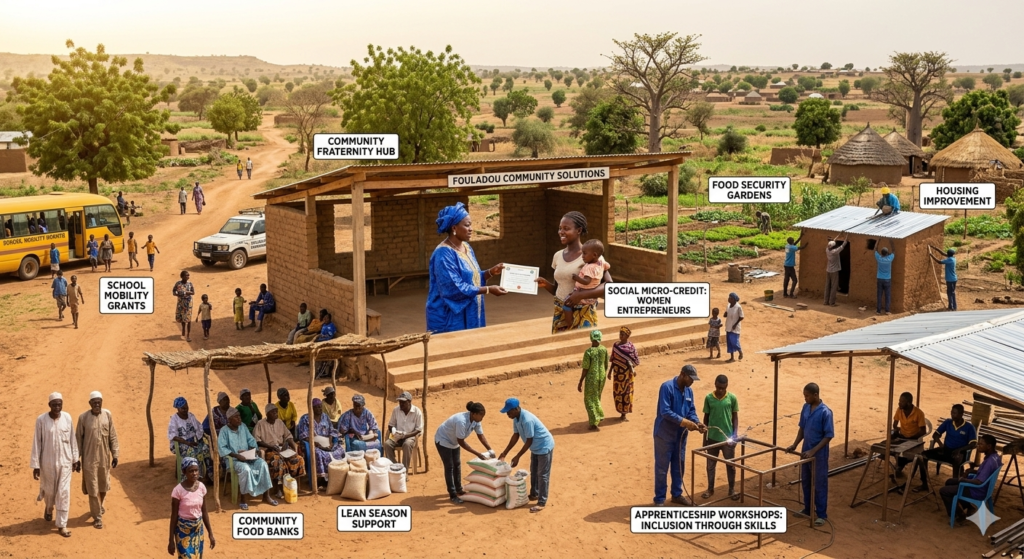
- Community Food Banks: Setting up locally managed security stocks to bridge the gap during the “lean season” (the period preceding the first harvests).
- Housing Improvement: Programs to renovate precarious housing to ensure a healthy and safe environment, particularly during the rainy season.
From Vulnerability to Autonomy: Inclusion through Activity
The most sustainable support is that which allows one to escape dependency.
- Social Micro-credit: Granting small interest-free loans to vulnerable women wishing to start small trade activities or local product processing.
- Apprenticeship Workshops: Integrating youth from underprivileged backgrounds into regional construction projects, offering them both an immediate income and qualifying training.
Priority Access to Basic Social Services
Vulnerability is often worsened by distance from services. The action plan includes:
- Reinforced Universal Health Coverage: Facilitating the enrollment of the poorest families so that healthcare is no longer a luxury.
- School Mobility Grants: Financial support for transportation and supplies for children in remote areas to break the cycle of illiteracy.
Conclusion: A Duty of Fraternity
Supporting the most vulnerable in Fouladou is not an act of charity, but an investment in the region’s social stability. By strengthening the weakest links, the entire chain of regional development becomes stronger and more resilient to crises.